How to Choose Risk Settings for Automated Trading (2026 Guide)
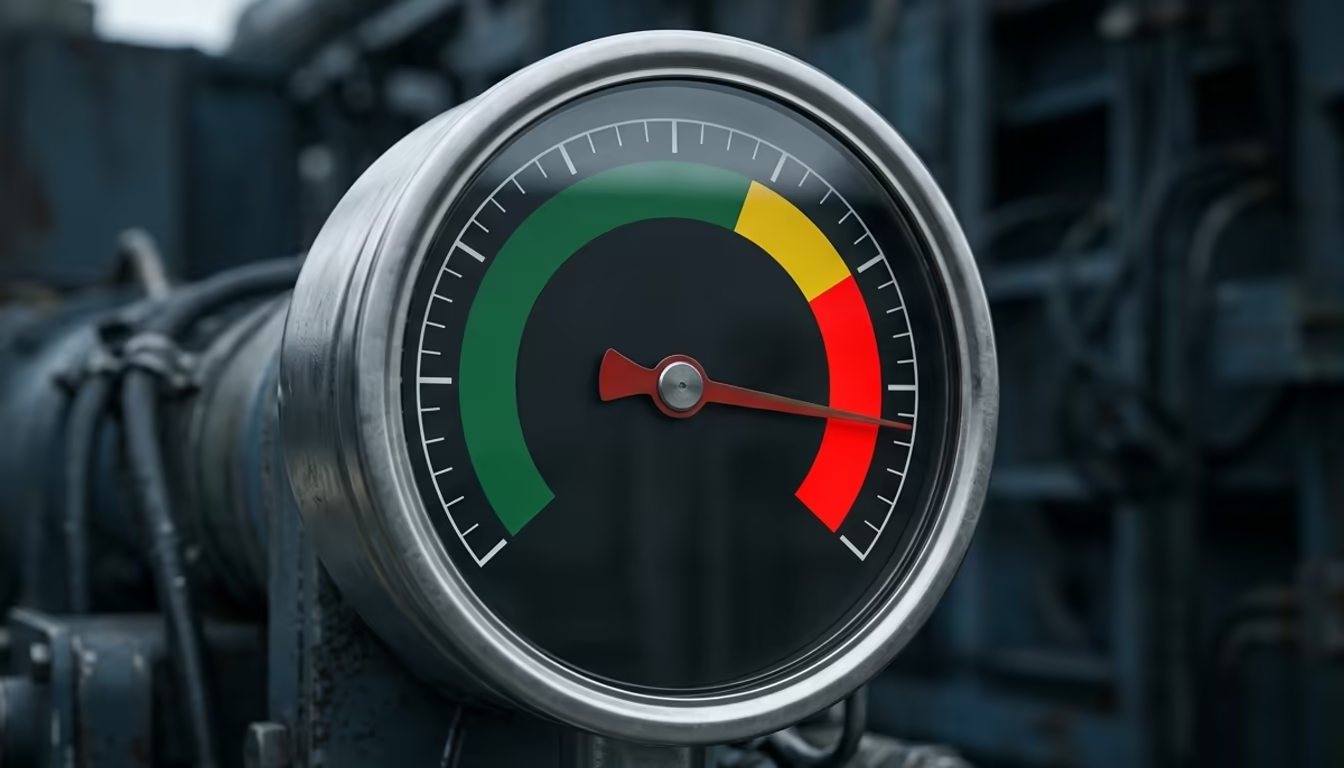
Choosing risk settings for automated trading means deciding, before you ever click "start," how much of your account you are willing to lose on a single trade, how large your position size will be relative to your stop-loss distance, and how much total drawdown you can tolerate before you intervene. For most retail accounts trading gold, risking 0.5% to 2% of equity per trade, using a fixed-fractional or risk-based lot-sizing model rather than fixed lot sizes, and picking a Conservative, Normal, or Aggressive mode that matches your account size and temperament is the practical starting point. The right setting is the one you can leave alone through a losing streak without shutting the system off.
In This Guide
- Why Risk Settings Matter More Than Strategy Selection
- The Core Risk Settings Every Automated System Uses
- Conservative, Normal, and Aggressive: How Risk Modes Actually Differ
- How to Calculate Position Size From Your Risk Setting
- Matching Risk Settings to Your Account Size and Goals
- Drawdown Tolerance: The Setting Behind the Setting
- Backtesting and Forward-Testing Your Risk Settings Before Going Live
Anyone who has installed an expert advisor (EA) and then stared at a settings panel full of unfamiliar fields (risk percentage, lot multiplier, stop distance, max open trades) already knows the real difficulty isn't finding a strategy. It's deciding how hard to press the accelerator. Automated systems remove emotion from trade execution, but they don't remove the human decision of how much risk to authorize. This guide walks through exactly how to set that number, with math you can apply to your own account, using a single XAUUSD system like Golden Viper EA or any other MT4/MT5 expert advisor from the MQL5 Market as the reference point.
Why Risk Settings Matter More Than Strategy Selection
Most new automated traders spend their research time comparing win rates, backtests, and strategy logic. Few spend any time on the input that actually determines whether they survive long enough to see those statistics play out: position size. A strategy with a 55% win rate and a 1:1.5 reward-to-risk ratio is profitable over a large sample, but run that same strategy at 10% risk per trade instead of 1% and it will produce account-ending drawdowns before the edge ever gets a chance to show up.
That's the core insight behind risk management as a discipline. The strategy determines whether you have an edge; the risk settings determine whether you get to keep trading long enough for that edge to matter. Automated systems raise the stakes here rather than lower them, because an EA executes your risk parameters exactly as configured, trade after trade, without hesitation or second-guessing. Get the setting wrong and the system will faithfully repeat that mistake at machine speed — which is why understanding how EA settings actually work before you go live matters more than tweaking indicator periods.
The Core Risk Settings Every Automated System Uses
Most expert advisors, regardless of the underlying strategy, expose some version of the parameters below. Knowing what each one actually controls is the first step toward setting them correctly.
Risk Per Trade (Percentage of Equity)
This is the single most consequential number in any automated trading setup. It defines what fraction of your current account balance or equity the system is willing to lose if a trade hits its stop. Set risk per trade to 1% on a $10,000 account and the maximum loss on any one trade, assuming the stop executes at the intended price, comes to $100.
Lot Sizing Method
There are two broad approaches. Fixed lot sizing trades the same lot size regardless of account balance or stop distance. It's simple, but your dollar risk changes every time your stop-loss distance changes, and for a volatile instrument like gold that distance can vary significantly day to day. Risk-based (or percentage-based) lot sizing calculates the position size dynamically from your risk percentage and the distance to your stop, so your dollar risk stays consistent even as market volatility shifts. Golden Viper EA uses risk-based lot sizing for exactly this reason — a wider overnight stop on a volatile session shouldn't silently double your dollar exposure.
Stop-Loss and Safety-Stop Distance
The stop-loss defines your maximum loss per trade in price terms. Some systems also use a secondary safety stop as a hard backstop against abnormal price gaps or connectivity issues. Where a strategy also locks in partial profit as a trade moves favorably, that mechanism protects gains without changing your original defined risk.
Maximum Open Positions and Exposure
Even a well-sized single trade can turn into an oversized bet if the system, or a combination of several EAs, opens multiple correlated positions at once. A cap on simultaneous open trades, or on total exposure to a single instrument like XAUUSD, keeps risk from compounding in ways the per-trade setting alone doesn't anticipate.
Maximum Drawdown Threshold
Some platforms and account-monitoring tools let you set an equity floor: a drawdown percentage at which the system pauses, or at which you intervene manually. This is less a trading parameter than a psychological circuit breaker. It matters because the biggest risk-management failures usually happen when a trader overrides a good system mid-drawdown, not when the system itself misbehaves.
Conservative, Normal, and Aggressive: How Risk Modes Actually Differ
Many gold-focused EAs, including Golden Viper EA, offer preset risk modes instead of asking you to configure every parameter from scratch. These modes typically scale the risk-per-trade percentage, and therefore the resulting lot size, up or down while leaving the underlying trend-and-momentum confirmation logic unchanged. The table below shows how a typical three-tier risk mode structure affects outcomes on a $10,000 account, assuming a stop-loss distance that risks the stated percentage per trade.
| Risk Mode | Typical Risk Per Trade | Approx. Dollar Risk ($10,000 acct) | Best Suited For |
|---|---|---|---|
| Conservative | ~0.5%–1% | $50–$100 | Capital preservation, new automated traders, smaller accounts, prop-firm evaluation phases |
| Normal | ~1%–2% | $100–$200 | Traders comfortable with moderate equity swings seeking a balance of growth and stability |
| Aggressive | ~2%–3% | $200–$300 | Experienced traders with a high drawdown tolerance and a clear exit plan if losses accelerate |
Notice what doesn't change across modes: the entry logic, the selectivity of the system, and the absence of martingale or grid-style averaging. Risk mode selection is purely a sizing decision, not a strategy decision, and that's exactly how it should work. A system that changes its trading logic based on a risk toggle is much harder to reason about than one that simply scales position size.
How to Calculate Position Size From Your Risk Setting
Once you've chosen a risk percentage, the actual lot size calculation follows a simple formula that any risk-based EA (or you, manually) performs before every trade:
Lot Size = (Account Equity × Risk %) ÷ (Stop-Loss Distance in Pips × Pip Value)
Here's the math in practice. Suppose you're trading XAUUSD with a $5,000 account, risk per trade set to 1%, and the strategy's stop-loss on a given H4 setup sits 400 pips (points) away from entry, with gold's pip value on a standard lot running roughly $1 per point of movement on most broker feeds (this varies by broker and contract specification, so confirm your own broker's exact pip value before trading).
Your dollar risk is $5,000 × 1% = $50. Divide that by the 400-point stop distance and you get a position size of roughly 0.125 standard lots, which most brokers would round to the nearest lot increment they support. Use a 2% Normal-mode setting instead on that same $5,000 account and the dollar risk doubles to $100, so the position size roughly doubles too, to 0.25 lots, for the identical stop distance. The strategy signal hasn't changed at all; only the size of the bet behind it has.
This is also why account size and risk percentage interact. A trader with a $1,000 account risking 1% per trade is only risking $10 per position, which on a volatile instrument like gold may round down to a lot size smaller than some brokers allow, effectively forcing either a higher risk percentage or a different lot-sizing approach. This is one of the more common frustrations with running an EA on a small account, worth reading in detail before funding a live account with less than a few hundred dollars.
Matching Risk Settings to Your Account Size and Goals
There's no single "correct" risk percentage. The right setting depends on account size, time horizon, and what the money is actually for. A trader building a long-term compounding position with capital they won't need for years can rationally tolerate more volatility than someone using an account for near-term income. Before you decide, it's worth working through how much capital you actually need to start EA trading, since undercapitalized accounts are frequently the real cause of "the risk settings didn't work" complaints, not the settings themselves.
As a general framework, smaller accounts (under $2,000) usually do better on Conservative settings, simply because a string of losses at higher risk percentages can shrink the account to a size where position sizing becomes impractical. Mid-size accounts ($2,000–$25,000) have more flexibility to run Normal settings and absorb a losing streak without meaningfully damaging long-term compounding. Larger accounts can sometimes justify Aggressive settings, but only once the trader has sat through a real drawdown at a lower risk level and knows, from experience rather than assumption, that they won't override the system emotionally.
This last point deserves emphasis: risk tolerance isn't just a math problem, it's a behavioral one. If a 15% drawdown at Normal risk would cause you to disable the EA mid-sequence, then Normal is the wrong setting for you, no matter what the expected-value math says, because a system you turn off during a drawdown never gets the chance to recover during the winning trades that follow.
Drawdown Tolerance: The Setting Behind the Setting
Every risk-per-trade decision is really a drawdown decision in disguise. Drawdown, the peak-to-trough decline in account equity, is the metric that actually determines whether a risk setting is sustainable for you, because it compounds losing trades into a single number you can measure against your own tolerance. For a deeper walkthrough of how consecutive losses translate into total drawdown, see this breakdown of how drawdown is calculated and why it matters more than win rate.
Consider two traders running the same strategy with a 45% win rate and a 1:2 reward-to-risk ratio, differing only in their risk-per-trade setting.
| Scenario | Risk Per Trade | 5 Consecutive Losses | Equity Impact |
|---|---|---|---|
| Conservative trader | 0.75% | 5 × 0.75% compounding losses | ≈ 3.7% drawdown |
| Normal trader | 1.5% | 5 × 1.5% compounding losses | ≈ 7.3% drawdown |
| Aggressive trader | 3% | 5 × 3% compounding losses | ≈ 14.1% drawdown |
Five consecutive losses isn't a worst-case scenario. It happens periodically to almost any selective strategy over a long enough sample, including highly selective, low-frequency systems that only take one qualifying XAUUSD setup per day. The question to ask before picking a risk mode isn't "can I afford this drawdown mathematically," it's "will I still trust the process and let the system run after seeing this number on my statement." If the honest answer for the Aggressive row is no, that tells you your real risk tolerance more accurately than any questionnaire would.
Backtesting and Forward-Testing Your Risk Settings Before Going Live
Risk settings should never be chosen in the abstract. They should be tested against historical price action and, ideally, observed in a demo or small live account before being scaled up. Both MetaTrader platforms include native tools for this: you can run a strategy tester across historical XAUUSD data to see how a given risk percentage would have performed through past volatile periods, a process covered in detail in a guide on how to backtest an EA on MT4, using the platforms' built-in automated trading and MQL5 documentation resources.
Backtesting shows you how a risk setting would have behaved historically, but it can't fully substitute for watching a system trade with real money on the line, because live spreads, slippage, and your own behavior under real drawdown all differ from a backtest report. That's why independently verified live results matter. A verified Myfxbook track record, confirmed through their account verification process, or a monitored MQL5 signal, gives you a real-money reference point for how a given risk mode has actually performed, including its real drawdown, not just a simulated one. Before committing your own capital, it's also worth reading about whether automated gold trading is realistically profitable, so your expectations are calibrated to real outcomes rather than marketing claims.
Red Flags: Risk Settings That Signal a Scam or an Unsustainable System
Risk settings are also one of the clearest tells for identifying automated trading systems that are poorly designed or outright fraudulent. Regulators including the CFTC and the FTC regularly publish warnings about automated trading systems that misuse risk settings to manufacture an attractive-looking track record while quietly loading up catastrophic tail risk. The CFTC's own advisory on trading system fraud specifically flags systems that guarantee returns or hide their true risk profile behind smooth equity curves.
| Red Flag | Why It's Dangerous |
|---|---|
| Martingale or grid "risk management" | Doubles or averages position size after losses, turning a normal losing streak into an account-blowing event; not a real risk control |
| "Guaranteed" or "risk-free" profit claims | No legitimate trading system can guarantee returns; this is a hallmark of the schemes both the CFTC and FTC warn about |
| No visible drawdown history | A track record with only gains and no visible drawdown periods is either cherry-picked, unverified, or too short to be meaningful |
| Fixed lot size regardless of account size | Ignores account equity entirely, so risk as a percentage of balance can silently balloon on smaller accounts |
| Unverified performance claims | Screenshots without third-party verification (such as Myfxbook's audited connection) can be fabricated or selectively edited |
If a system's marketing leans on the word "guaranteed" anywhere near its risk settings, that alone should end the evaluation. It isn't just an honesty issue; it's a signal the seller doesn't understand, or is deliberately obscuring, how position sizing and drawdown actually interact. A well-designed EA will instead show you its actual risk modes, its verified drawdown history, and let you choose a setting that matches your own tolerance rather than promising outcomes no rules-based system can control.
Adjusting Risk Settings as Your Account and Experience Change
Risk settings aren't a "set once and forget" decision. As your account grows or you gain experience watching a system trade through different conditions, it's reasonable to revisit your risk mode. A trader who started at Conservative on a $2,000 account and has since watched two full drawdown cycles play out as expected, with the account recovering afterward, has real evidence to support stepping up to Normal. A trader who has only seen winning months has no such evidence yet, no matter how confident they feel.
It's also worth thinking about risk at the portfolio level, not just per trade. Run more than one automated system, or trade gold alongside other instruments, and your effective account-wide risk becomes the sum of each system's exposure, which can compound in ways that aren't obvious from any single EA's settings panel. This is covered in more depth in guides on diversifying across multiple EAs and on how compounding interacts with risk settings over time: a 1% per-trade setting compounds very differently across a year of consistent execution than a single aggressive month does.
One structural safeguard worth understanding, regardless of which risk mode you choose, is trade identification. Serious traders running more than one strategy or EA on the same account rely on magic numbers to separate each system's trades, which matters for risk management because it lets you audit exactly how much of your drawdown came from which system rather than treating your account as one undifferentiated blur of trades.
Practical Checklist: Setting Up Risk Before You Go Live
Before enabling any automated system on a funded account, work through this sequence rather than accepting the default settings unread.
Start by confirming your account's actual pip or point value for the instrument you're trading, since gold's contract specifications vary by broker and directly affect the lot-size math above (a detail explored further in comparisons of broker spreads and specifications for gold trading). Next, pick a risk mode based on account size and honest drawdown tolerance, not how fast you want to grow the account. Then backtest that setting across at least a full year of XAUUSD price history, including known volatile periods, before moving to a demo account for live forward-testing. Only after watching real trades at your chosen setting, and confirming you're comfortable holding through a losing sequence, should you fund a live account, and even then, start with capital you can actually afford to lose.
A Short, Honest Risk Disclosure
Automated trading, including gold-focused expert advisors, carries real financial risk. No risk setting, risk mode, or strategy eliminates the possibility of losses, and past performance, whether backtested or from a verified live track record, does not guarantee future results. Position sizing and drawdown limits reduce the size of individual losses; they do not prevent them. Only trade with capital you can afford to lose, and treat every risk percentage discussed in this guide as a starting point for your own research, not personalized financial advice.
Frequently Asked Questions
What risk percentage should beginners use for automated gold trading?
Most beginners are better served starting at 0.5% to 1% risk per trade, often labeled a "Conservative" mode, until they've watched the system trade through at least one meaningful drawdown and confirmed they're comfortable with the equity swings involved. You can always increase risk once you have real experience; reducing it after an account has already been damaged by outsized losses is a much harder recovery.
Is a higher risk setting always more profitable over time?
Not necessarily, and often not at all once drawdown-driven behavior is factored in. Higher risk settings increase both the size of wins and the size of losses proportionally, and larger drawdowns are statistically more likely to push a trader into shutting the system off mid-sequence, which erases the long-run edge the strategy was built to capture. Sustainable profitability usually favors a risk level you can hold through consistently over one that maximizes theoretical growth on paper.
What's the difference between fixed lot size and risk-based lot sizing?
Fixed lot sizing trades the same position size every time, regardless of account balance or stop distance, which means your actual dollar risk fluctuates with market volatility. Risk-based lot sizing recalculates position size before every trade using your account equity, chosen risk percentage, and the current stop-loss distance, so your dollar risk stays consistent even as gold's volatility shifts from one setup to the next.
How much drawdown is considered normal for an automated XAUUSD strategy?
There's no universal number, since it depends heavily on the risk-per-trade setting chosen, but double-digit percentage drawdowns are common even for well-designed, selective strategies over a long enough sample, simply because any losing streak compounds. What matters more than the raw number is whether the drawdown stayed within the range implied by your chosen risk setting and whether the account recovered afterward, best evaluated against a verified live track record rather than assumptions.
Should I change my risk settings after a losing streak?
Generally no, provided the losing streak stayed within statistically normal bounds for your strategy's win rate, reward-to-risk ratio, and chosen risk-per-trade percentage. Changing settings reactively after every losing streak, rather than proactively based on account size and tested drawdown tolerance, is one of the more common ways automated traders undermine a system that was otherwise working as designed.
Do martingale or grid systems count as risk management?
No. Martingale and grid approaches increase position size or open additional positions after losing trades in an attempt to recover losses faster, which is the opposite of risk management — it concentrates risk exactly when a losing streak is already underway. Systems built this way can look stable for long stretches and then produce a single catastrophic loss that erases months of gains, which is why confirming their absence is worth doing before trusting any automated system.
How do I know if a live track record's risk settings are trustworthy?
Look for independent, third-party verification rather than screenshots. A connected and verified Myfxbook account or a monitored MQL5 signal both display real trade history, real drawdown, and real timestamps that can't be edited after the fact. Cross-reference the displayed risk-per-trade behavior against the stated risk mode, and stay skeptical of any track record that shows only gains with no visible drawdown periods, a common marker of curated or fabricated results the CFTC and FTC both warn about.
Can I run different risk settings on MT4 versus MT5 for the same strategy?
If the underlying EA supports both platforms under a single license, the risk settings and calculation logic are typically identical across MT4 and MT5, since the risk-per-trade and lot-sizing formulas don't depend on the platform itself. Any difference you observe in practice usually comes down to broker-specific contract specifications or execution conditions rather than the platform, so it's worth confirming pip values and spreads on each account separately.
How does account size affect which risk setting makes sense?
Smaller accounts often need either a higher risk percentage to produce a tradeable lot size or a broker that supports micro-lot increments, since a very low dollar risk on a small account can round down to a position size below the broker's minimum. Larger accounts have more flexibility to run lower risk percentages while still producing meaningful position sizes, one reason it's worth reading dedicated guidance on capital requirements before assuming a single risk percentage applies equally to every account size.
What's the fastest way to sanity-check a risk setting before going live?
Run the position-size formula manually for your actual account balance, your broker's real pip value, and your strategy's typical stop-loss distance, then ask whether you'd be comfortable losing that dollar amount five times in a row without changing anything. If the answer is no, the setting is too aggressive for you regardless of what the backtest or verified track record shows, because your own behavior under drawdown is as much a part of the system's real-world performance as the strategy's entry logic.
Let Golden Viper EA trade gold for you
Automated XAUUSD trading for MT4 & MT5, verified live on Myfxbook. One-time $199, lifetime access.
Get Lifetime Access — $199